
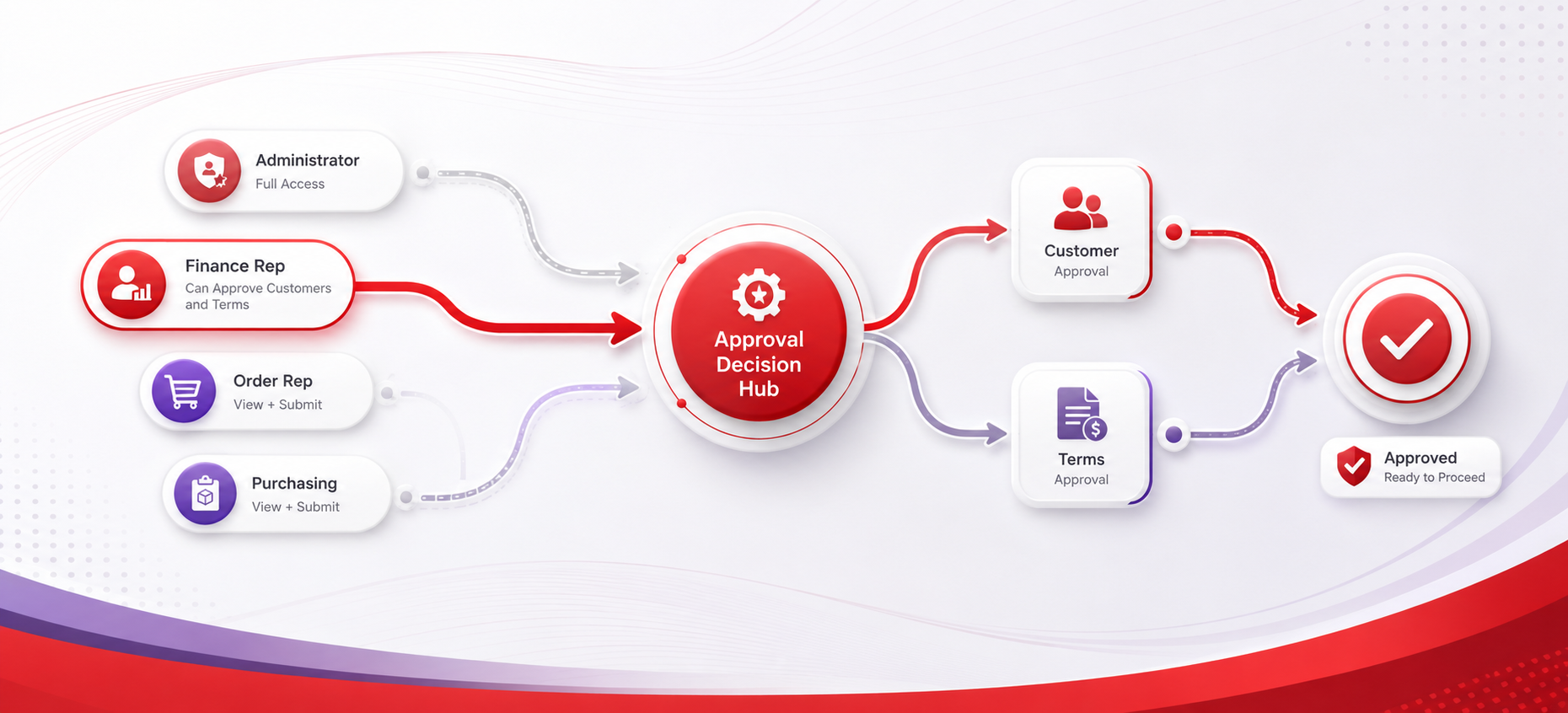
As a promotional products business grows, one of the hardest things to manage is not the order itself — it is deciding who is responsible for reviewing important internal decisions.
Elite Core’s Operations Management area gives administrators and internal management teams a central place to control that responsibility. Instead of relying on informal emails, hallway conversations, or assumptions about who should approve something, Operations Management lets the business define clear reviewer relationships for operational workflows.
What is Operations Management in Elite Core?
Operations Management is an administration layer that sits behind important internal workflows in Elite Core.
Administrators can use it to define:
- Which operational workflow is being managed
- Which management team is responsible for oversight
- Which operational team the rule applies to
- Which individual reviewer should receive the request
- Whether that reviewer receives email notifications
- Whether they receive in-app notifications
- Whether they have authority to approve the request
- Whether the assignment is currently active
This gives management a much clearer way to establish accountability across departments and teams.
Customer Review
One of the primary workflows managed through Operations Management is Customer Review.
Customer Review helps control lead-to-customer and client-to-customer review activity. Rather than allowing important customer-account decisions to move forward without oversight, Elite Core can route those requests to the appropriate management team and reviewer.
For example, an organization can configure a specific management team to review customer-related requests originating from a particular sales or operational team.
The result is a more structured process for deciding who reviews important customer changes and who ultimately has authority to approve them.
Customer Terms Review
Operations Management also includes a separate Customer Terms Review workflow.
This workflow is designed for situations where an authorized sales or operations user requests different payment terms for a customer, a project, or both.
Instead of changing financial terms without oversight, the request can be routed to an assigned reviewer for approval.
Administrators can enable or disable Terms Review independently from Customer Review, allowing the company to decide how much governance is appropriate for its own processes.
Require Customer Review Before Terms Approval
Elite Core can also connect these two workflows.
An administrator can require Customer Review to be completed before a Terms Review request can be approved.
This creates a useful internal control for organizations that want customer-account changes reviewed before financial terms are altered.
For example:
- A sales representative requests different payment terms.
- The request enters the Terms Review workflow.
- If Customer Review is required first, the customer-review process must be completed.
- The authorized terms reviewer can then make the final approval decision.
This creates an intentional approval sequence instead of treating each request as an isolated action.
Management Team Routing
The strength of Operations Management is that review responsibility does not have to be assigned globally to one person.
Administrators can create workflow assignments based on teams.
A workflow assignment can define a Managing Team, the team the rule Applies To, and a specific reviewer from within the managing team.
This means different parts of the organization can have different management structures.
For example, one sales team could report to one reviewer while another team could report to a different management group. Elite Core can route requests according to those relationships rather than forcing every request through the same person.
Choose the Actual Reviewer
Within the managing team, an administrator can select the individual user responsible for reviewing the workflow.
This is important because a department may contain several managers, but only one person may currently be responsible for a particular type of approval.
That reviewer relationship can be changed as responsibilities change without redesigning the entire workflow.
Email and In-App Notifications
Operations Management also controls how reviewers are notified.
Each workflow assignment can determine whether the reviewer receives:
- Email notifications
- Elite Core in-app notifications
- Both
This gives companies flexibility in how management requests are surfaced while still keeping the actual workflow inside Elite Core.
Approval Authority
Being notified about a request does not necessarily mean someone should be able to approve it.
Operations Management includes a separate control for whether the assigned reviewer can approve the workflow.
This helps separate visibility from authority. A manager can be included in a workflow for awareness while approval rights remain limited to the appropriate person.
Fallback Protection for Terms Review
Elite Core also includes fallback handling for Customer Terms Review.
If Terms Review is enabled but no active reviewer assignment matches the requesting user’s team, the request can be sent to a configured fallback email address for manual review.
This helps prevent an important payment-term request from disappearing simply because a management relationship has not yet been configured.
Why This Matters for Internal Management
Many ERP systems are good at recording what happened but provide less control over who should make the decision before it happens.
Operations Management is designed to address that internal-management layer.
It gives administrators a centralized place to define operational accountability while giving management visibility into the workflows they are responsible for.
That can help reduce:
- Unclear approval responsibility
- Requests being sent to the wrong manager
- Financial-term changes without appropriate review
- Important customer decisions being handled only through email
- Different teams following completely different informal processes
Built to Expand with Operational Workflows
The management-routing model is intentionally broader than one specific approval screen. It establishes a foundation for assigning management responsibility to operational workflows inside Elite Core.
Today, the explicit workflows include Client-to-Customer Review and Customer Terms Review. The same underlying structure — managing team, applicable team, reviewer, notifications, approval authority, and active status — provides a framework that can support additional operational review processes as Elite Core continues to evolve.
A Central Place for Operational Accountability
The goal of Operations Management is simple: make it clear who is responsible.
Administrators establish the rules. Management teams receive the appropriate requests. Reviewers know what requires their attention. Sales and operations teams know where decisions are going.
Instead of creating more administrative work, Elite Core uses these relationships to make internal oversight part of the normal operational workflow.
For organizations with multiple sales teams, managers, departments, and approval requirements, that creates a more scalable way to manage the business as it grows.